
Retroreflection — How glass beads make our tracking possible
How retroreflective glass beads in ART markers send infrared light back to the camera that triggered the flash — and why that is essential for DTRACK.
Why passive markers glow so brightly in the IR image
ART tracking cameras emit short infrared flashes and capture the returning light. Passive markers are not LEDs — they reflect the camera light. To detect a small point reliably from several metres away, you need retroreflection, not diffuse scatter: light should return toward the source as much as possible.
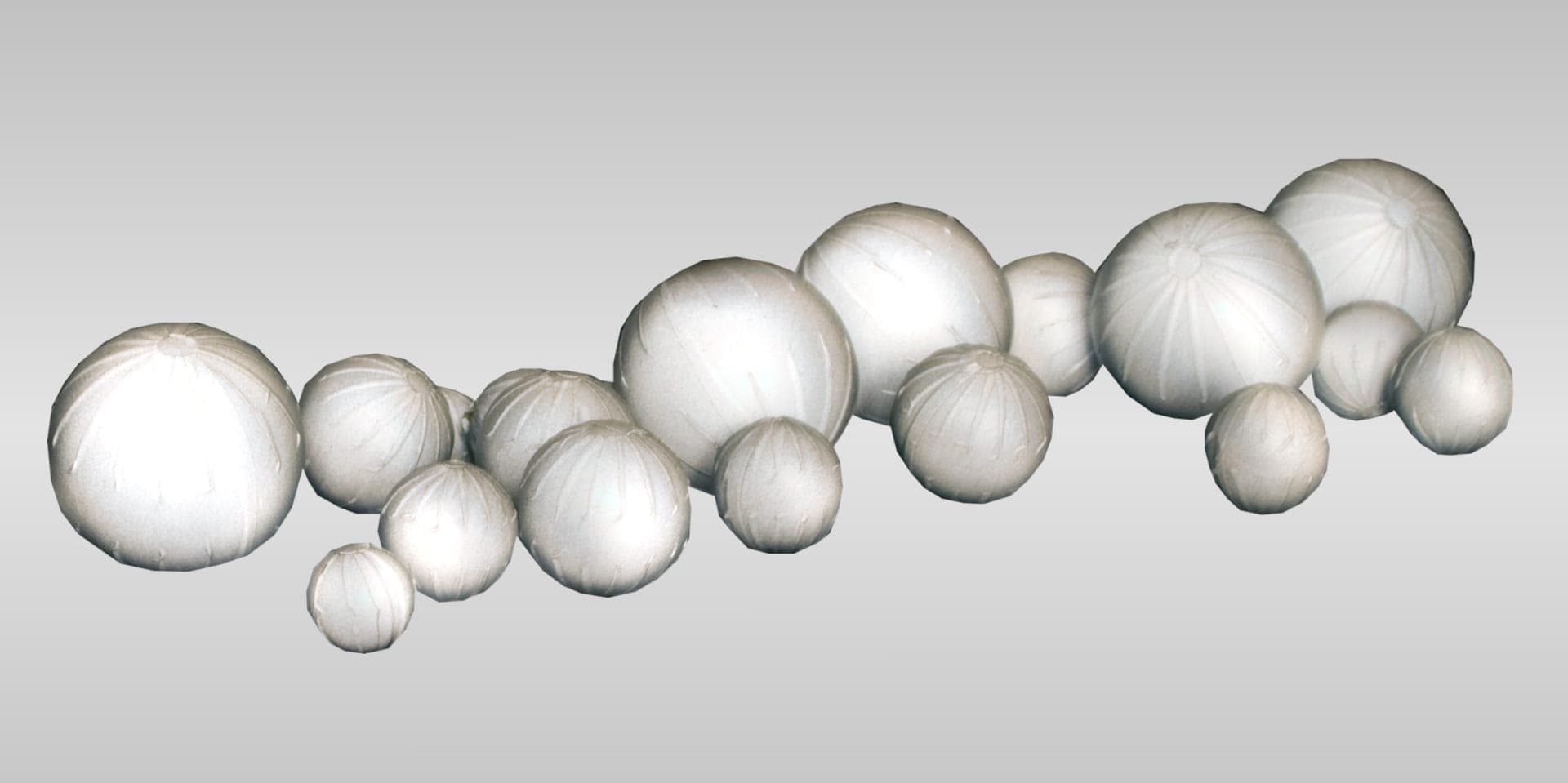
Figure: Passive spherical markers with 3M retroreflective sheeting — the bright surface reflects the camera’s IR flash back.
Our spherical markers use high-grade 3M retroreflective materials (Scotchlite® technology): a layer of glass microspheres embedded on a reflective backing.
What retroreflection means in physics
A normal white diffuser scatters light in many directions — only a fraction reaches the camera. A mirror reflects at a fixed angle (angle of incidence equals angle of reflection).
Retroreflectors are designed so that most incoming light returns almost parallel to the incident ray — back to the camera that emitted the IR flash. In a multi-camera setup, each camera views the marker from a different direction; the marker must still reflect each flash reliably back to the camera that triggered it.
Glass beads and total internal reflection
The illustration below shows spherical retroreflection — rebuilt from the Wikipedia diagram by Cmglee (see source note under the image).
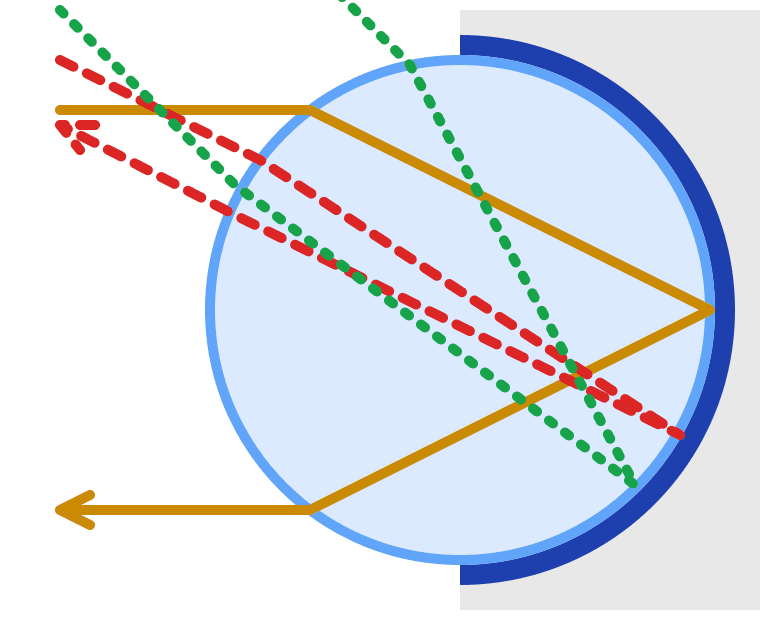
Figure: Reproduction of the spherical retroreflector (panel 2) from “Comparison of retroreflectors” by Cmglee, Wikimedia Commons, licensed under CC BY-SA 3.0; modified (cropped to the sphere geometry, colours adapted).
In 3M sheeting, thousands of tiny glass spheres sit partially embedded in a metallic reflective layer. A typical light path:
- The camera’s IR flash hits the marker surface.
- Light refracts as it enters the glass bead (air → glass boundary).
- Inside the sphere, the ray reaches the rear side (glass against the reflective backing).
- At the right angle, total internal reflection occurs at the boundary — the ray stays inside the sphere instead of escaping into the substrate.
- On exit, light refracts again and leaves the surface toward the camera.
That produces the characteristic bright spot in the IR image that DTRACK detects as a marker — light returns toward the triggering flash, not only at a mirror’s fixed reflection angle.
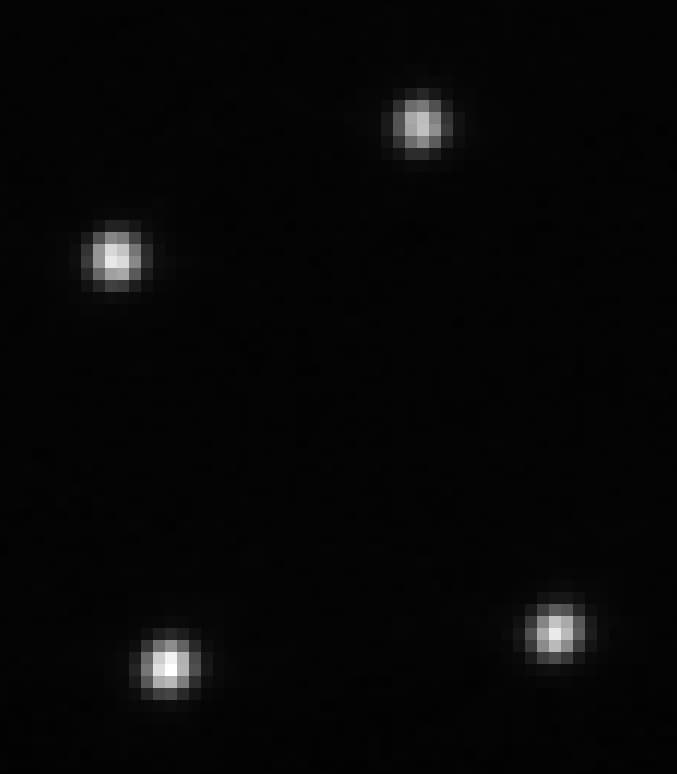
Figure: Markers in an image from an ART tracking camera.
Spherical and flat markers
Round markers add a benefit: from any direction, a curved retroreflective surface is visible. Flat stickers can lose effective reflection at steep angles; a sphere delivers stable reflection over a wide angular range — important for moving targets on tools, HMDs, or robots.
Depending on the application, ART also supports flat markers — for example when space is limited, camera viewing angles are constrained, or a flat mounting surface dictates the geometry. Both variants use the same retroreflective material; the choice depends on mounting, visibility, and movement within the tracking volume.
The spherical geometry also helps sub-pixel centroid detection in the camera image: DTRACK evaluates the bright core of the IR return to compute 2D position on the sensor — the basis for 6DOF tracking in space.
Practice: material, care, replacement
- Clean surface: Dust and grease reduce retroreflection — inspect markers regularly.
- Avoid direct sunlight / strong IR sources: can cause saturation or interference.
- Genuine material: For reproducible reflection we rely on certified 3M retroreflective films — not generic “reflective” tape.
Ready-made markers, diameters, and sets are available in the ART marker shop. Overview of markers, targets, and active variants: Products — markers & targets.
Next steps
- Targets & calibration: Target calibration in DTRACK — practical tips
- Software: DTRACK4 features
- Applications: Marker tracking use cases